Rugby Sevens Rules Explained: Scoring, Match Time and Cards
Rugby sevens is played by seven players per team on a full-size rugby field. A standard match has two seven-minute halves, a try scores five points, conversions are drop-kicked, and the team that scores takes the next restart.
- Players on field
- 7 per team
- Standard match
- 2 × 7 minutes
- Half-time
- Up to 2 minutes
- Yellow card
- 2-minute suspension
Seven players, seven-minute halves, quick restarts and little room for error
Sevens uses the basic laws of rugby union with format-specific variations. Seven players cover the full field, standard halves last seven minutes, conversions are drop-kicked, and the team that scores takes the next restart.
- Players: no more than seven from each team are on the field during play.
- Time: a standard match lasts 14 minutes plus time lost.
- Restart: the scoring team kicks off again and can compete to regain the ball.
- Cards: a yellow card removes a player for two minutes.
Rugby sevens rules in one minute
The aim is to score more points than the other team. Players may run with the ball, pass it sideways or backwards, and kick it in any direction. A forward pass or knock-on normally gives the other team a scrum. A try is scored by grounding the ball in the opponents’ in-goal area.
Most rugby union laws still apply. The sevens variations change the number of players, timing, conversions, restarts, scrums, replacements and card duration so a tournament can move quickly from one match to the next. The Singapore SVNS 2027 guide separates these general laws from event-specific schedules and regulations.
- Seven players from each team may be on the field during play.
- The match uses a full-size rugby union field.
- The ball cannot be passed forward by hand.
- A player may kick the ball forward, but chasing players must remain onside.
- A try is scored by grounding the ball in the opponents’ in-goal.
How long a rugby sevens match lasts
A standard match lasts 14 minutes: two halves of no more than seven minutes, plus time lost. Half-time lasts no more than two minutes. The short clock means a team may have only a few possessions in which to recover from a mistake.
World Rugby’s variations allow a competition final to last up to 20 minutes, split into halves of no more than 10 minutes. This is permission, not a promise that every final uses longer halves. The tournament regulations and published fixture schedule control the actual format.
What happens if a knockout match is tied?
When a drawn knockout match requires extra time, play restarts after a one-minute break. Extra-time periods last no more than five minutes. The teams change ends after each period without another interval, and the first team to score wins immediately.
Rugby sevens scoring
The point values are the same as in rugby union, but sevens uses drop-kicked conversions to keep play moving. The conversion must be taken within 30 seconds of the try. Opponents assemble near their own 10-metre line instead of charging the conversion.
A penalty-goal attempt must also be taken within 30 seconds. Under the sevens variation, the kick must be a drop kick rather than a place kick.
| Scoring action | Points | What it means |
|---|---|---|
| Try | 5 | Ground the ball in the opponents’ in-goal. |
| Conversion | 2 | A drop kick taken after a try. |
| Penalty goal | 3 | A drop-kicked attempt after an eligible penalty. |
| Drop goal | 3 | A drop kick at goal during open play. |
Kick-offs and restarts after a score
The team that scores takes the next restart with a drop kick from on or behind the centre of halfway. It must restart within 30 seconds after the conversion is taken or declined, or after a penalty or drop goal.
The kick must travel at least 10 metres and must not go directly into touch. Team-mates of the kicker must start behind the ball. These details matter because an accurate high restart can let the scoring team compete for possession again instead of handing the ball back.
- Scoring team: takes the restart.
- Time limit: 30 seconds.
- Distance: the ball must reach the 10-metre line.
- Directly into touch: results in a free kick to the non-kicking team.
Tackles, rucks, offside and the breakdown
A legal tackle brings the ball carrier to ground. The tackler must release and move away, while the tackled player must release, pass or place the ball. Arriving players who contest possession must enter legally, stay on their feet and remain onside.
Because there are fewer supporting players, a turnover at the breakdown can expose a large area immediately. Teams often decide between committing players to protect the ball and keeping them spread across the field.
Why did the referee stop play?
These are common outcomes for a new viewer. The precise sanction depends on the facts the referee sees.
- Forward pass or knock-on: normally a scrum to the other team.
- Ball or ball carrier goes into touch: normally a lineout.
- Player contests from an offside position: penalty.
- Tackler fails to release or roll away: penalty.
- Dangerous or repeated foul play: penalty and possible card.
Scrums, lineouts and penalties
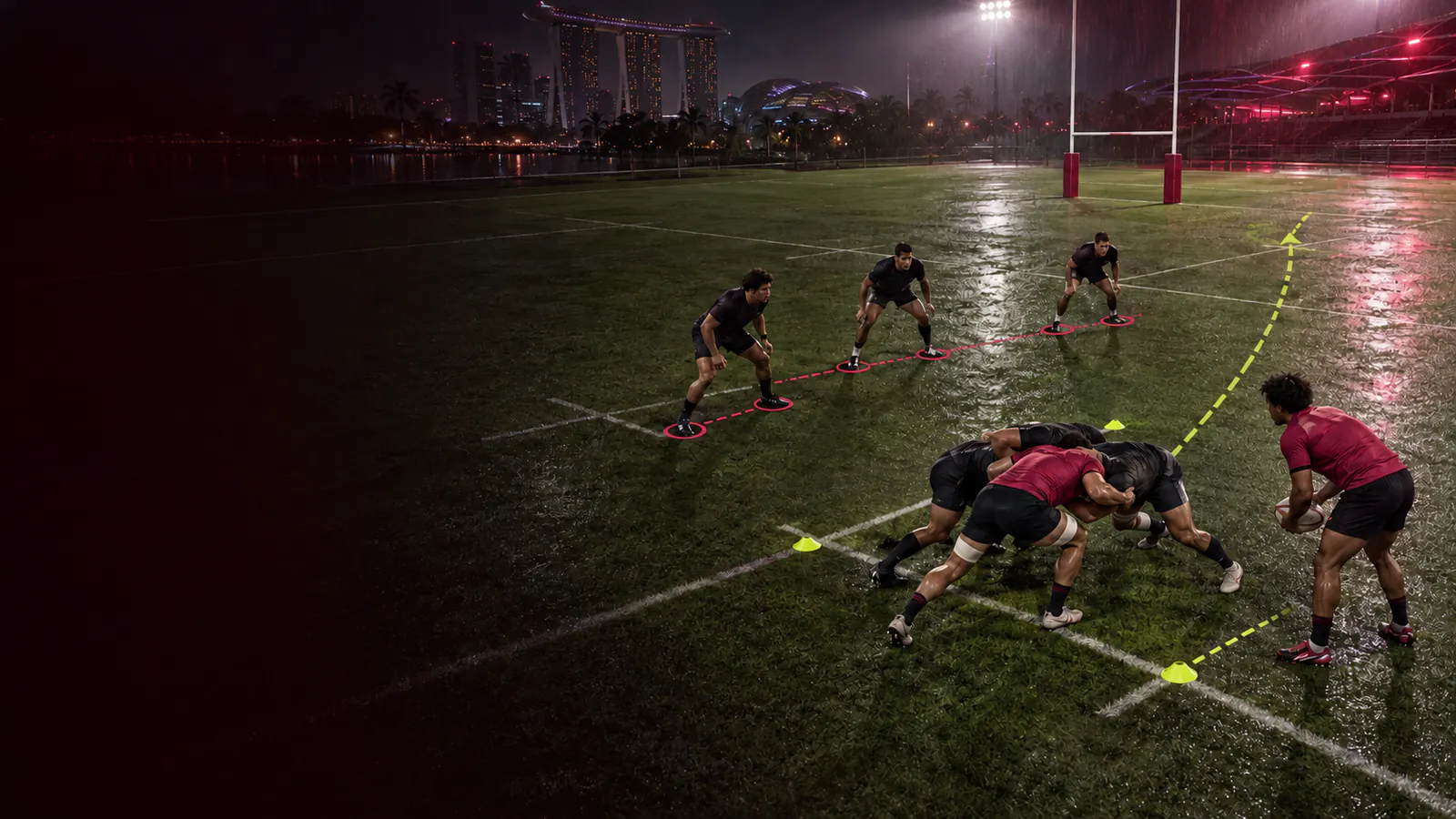
A sevens scrum has three bound players from each team and must be ready within 15 seconds of the mark. With only three players tied into the scrum, the remaining players have more field to defend once the ball comes out.
A lineout restarts play after the ball goes into touch. A penalty gives the non-offending team several tactical choices, including a quick tap, a kick to touch or an attempt at goal when allowed. Sevens teams often restart quickly before the defence can reorganise.
- Scrum: three players from each team.
- Scrum set-up: teams must be ready within 15 seconds.
- Lineout: restarts play after the ball goes into touch.
- Penalty or free kick: the kicker may punt or drop-kick, but may not place-kick the restart.
Yellow cards, red cards and replacements
A yellow card in sevens suspends the player for two minutes. During that time the team plays with six, so the missing defender represents one seventh of the original on-field team. Opponents will usually move the ball to make that reduced defence cover as much width as possible.
A second yellow-card offence sends the player off. A red card also removes the player for the rest of the match. World Rugby’s team variation allows a side to nominate and use up to five replacements, subject to the competition regulations and the laws governing tactical, injury and temporary replacements. For a current event, use the teams and line-up guide to distinguish an announced tournament squad from a wider national programme.
Rugby sevens compared with fifteen-a-side rugby
The field and basic object stay familiar, but the format changes the pace and the cost of each mistake. This table covers the differences a spectator is most likely to notice. The Singapore rugby history guide explains how the sevens format fits into the local game without merging separate competitions.
| Rule or format | Rugby sevens | Fifteen-a-side rugby |
|---|---|---|
| Players on field | 7 per team | 15 per team |
| Standard match | 2 × 7-minute halves | 2 × 40-minute halves |
| Half-time | Up to 2 minutes | Up to 15 minutes |
| Scrum | 3 players per team | 8 players per team |
| Conversion | Drop kick | Place kick or drop kick |
| Restart after score | Scoring team restarts | Non-scoring team restarts |
| Yellow-card suspension | 2 minutes | 10 minutes |
How to follow a sevens match as a new viewer
Do not try to learn every law during the first match. Follow the score, possession and number of players first. The referee’s signal and the restart then tell you what happened. Keep the fixtures and results open to confirm the match stage and whether a score is live or final.
- Check the score and how much time remains.
- Notice which team has possession and where the open space is.
- After a try, watch the quick drop-kicked conversion.
- Watch the scoring team compete for its own restart.
- If a card appears, count the remaining defenders and watch how the attack uses the extra space.
- After the match, check that the score is labelled final before treating it as a completed result.
Common questions
How many players are in a rugby sevens team?
No more than seven players from each team may be in the playing area during play. A team may nominate and use up to five replacements under the World Rugby sevens variation.
How long is a rugby sevens match?
A standard match has two halves of no more than seven minutes, plus time lost. Half-time lasts no more than two minutes.
How long is a yellow card in rugby sevens?
A yellow card suspends the player for two minutes. A second yellow-card offence sends that player off.
Who kicks off after a try in rugby sevens?
The team that scored takes the restart with a drop kick from on or behind the centre of the halfway line.
What happens when a knockout match is tied?
After a one-minute break, extra time is played in periods of no more than five minutes. The first team to score wins immediately.
Are all rugby sevens finals 20 minutes long?
No. World Rugby permits a competition final to last up to 20 minutes, but the competition regulations and published schedule determine whether longer halves are used.
Sources used on this page
- Rugby sevens law variationsWorld Rugby
- Rugby sevens team variationsWorld Rugby
- Rugby sevens scoring variationsWorld Rugby
- Rugby sevens kick-off and restart variationsWorld Rugby
- Rugby sevens scrum variationsWorld Rugby
- Rugby sevens foul-play variationsWorld Rugby
- Rugby sevens penalty and free-kick variationsWorld Rugby
- Laws of the GameWorld Rugby